
When deciding between Echo Pop Vs Echo Dot, the choice ultimately comes down to what you value most in a smart speaker: affordability, compact size, good-enough sound, or richer audio and smarter home integrations. Both deliver the core Alexa experience — from voice commands and automation to music and information — but their design, audio behavior, and feature sets differ in meaningful ways. In this deep dive, we’ll carefully examine these differences so you can decide which speaker best fits your home and lifestyle.
- Understanding the Basics: What Are Echo Pop and Echo Dot
- Design and Aesthetic Differences
- Audio Performance — Who Sounds Better?
- Smart-Home Features and Functionality
- Price and Value — Which Offers Better Bang for Your Buck?
- Use-Case Scenarios — When Pop Makes Sense vs When Dot Is Better
- Pros and Cons — Crunching the Trade-Offs
- Which Should You Buy? — A Decision Guide
- Conclusion
- Frequently Asked Questions
- FAQ
Understanding the Basics: What Are Echo Pop and Echo Dot
Echo Pop and Echo Dot are compact smart speakers designed by Amazon to bring the Alexa voice assistant into your home. They both connect via Wi-Fi and Bluetooth, respond to voice commands with Alexa, and support smart-home control and automation. However, their physical design, internal hardware, and additional capabilities diverge — making each one better suited to slightly different use cases.
The Echo Pop is positioned as Amazon’s most affordable full-featured smart speaker, meant for basic Alexa tasks and casual listening in smaller rooms. Meanwhile, the Echo Dot is slightly more expensive but aims to deliver a more rounded audio experience and richer smart-home integration, making it a more “full-featured” option within Amazon’s entry-level smart speaker lineup.
With those basics in mind, let’s turn to a head-to-head on design, sound, smart-home features, usability, and price.
Design and Aesthetic Differences
Visually, Echo Pop and Echo Dot follow a similar minimalist, compact ethos — but with distinct shapes and styling that affect how they feel in a room.
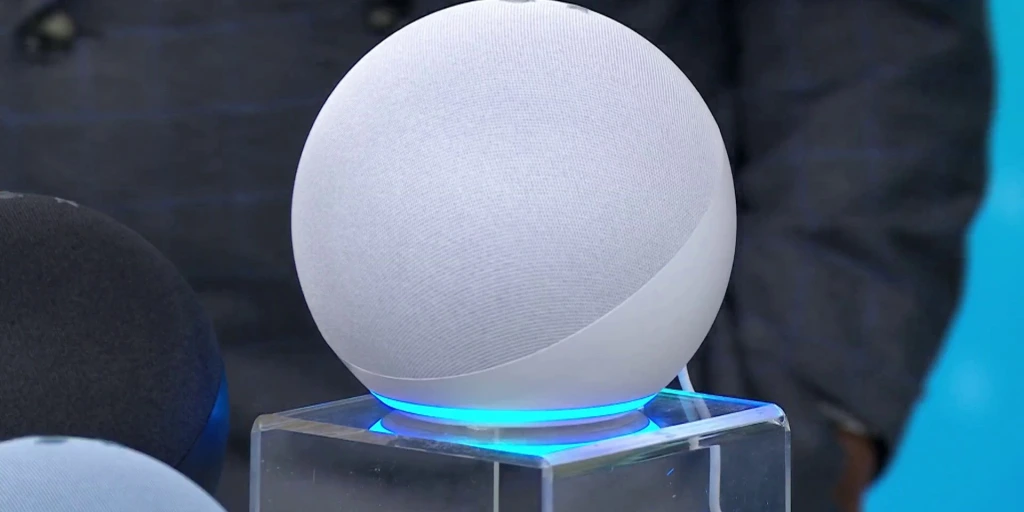
Echo Pop has a semi-sphere or “half-moon” design: flat at the front (where the speaker fires), with a curved back. Echo Dot, by contrast, retains a fully spherical form with fabric covering and a more “classic” smart-speaker look, which some may find more premium or home-friendly depending on décor.
In terms of size and weight, they’re comparable. The Pop measures roughly 3.9 x 3.3 x 3.6 inches, while the Dot comes in at about 3.9 x 3.9 x 3.5 inches. In practice, the Pop is only slightly smaller and significantly lighter than the Dot, but not so dramatically so that size alone is a major deciding factor.
Where Echo Pop tends to stand out is with its variety of colour options and playful aesthetic choices. It often comes in shades like Lavender Bloom or Midnight Teal, while Echo Dot stays with more muted finishes such as Charcoal, Glacier White, or Deep Sea Blue. If you care about style or want the speaker to blend (or pop) as décor, that’s something to consider.
As for controls and status indicators: both have basic volume controls and mute buttons, but Echo Dot adds an “action” button, allowing for alternate ways to summon Alexa (without voice), answer or reject calls, or trigger smart-home routines manually. The visual indicator for Alexa’s listening state also differs: Dot has a full ring light at the base, while Pop features a smaller light segment at the top.
Overall, if aesthetic flexibility, lighter weight, and a compact footprint matter to you — especially in smaller rooms or bedrooms — Echo Pop’s design might appeal. If you prefer a more “classic” smart-speaker look with a slightly premium feel, Echo Dot might be more to your liking.
Audio Performance — Who Sounds Better?
When it comes to sound — one of the most important aspects if you plan to use your device for music, podcasts, or ambient audio — Echo Pop and Echo Dot differ significantly in character.
Echo Pop boasts a 1.95-inch front-firing speaker, slightly larger on paper than the 1.73-inch driver inside the Echo Dot. Intuitively, you might expect that larger speaker to translate to stronger audio — but in reality, speaker size isn’t the only measure of sound quality. Reviews note that despite the bigger driver, the Pop often lacks warmth, bass, and fullness. High-frequency sounds may come across sharply or even harshly when volume is cranked.
In contrast, Echo Dot’s spherical design and acoustic tuning give it a wider soundstage and better bass response, producing deeper, fuller, and overall more balanced audio — especially noticeable on music, movies, or more complex soundtracks. This makes Dot the stronger performer if you care about sound quality beyond spoken-word tasks like timers, alarms, or simple Alexa responses.
That said, Echo Pop is still “good enough” for smaller spaces or casual listening: it’s loud enough to fill a standard-size bedroom or kitchen, and speech — like Alexa’s replies, podcasts, or audiobooks — often comes through clearly and intelligibly. But once you push volume high or try bass-heavy music, the Pop’s limitations become more apparent.
Therefore, if you’re mostly using the speaker for Alexa tasks, background music, or occasional listening in small spaces, Echo Pop may suffice and deliver reasonable value. If you want richer, more immersive sound for music or media, Echo Dot is the safer bet.
Smart-Home Features and Functionality
Beyond sound and style, one of the main reasons to buy an Alexa speaker is smart-home control and automation — and here, Echo Dot pulls ahead in several ways.
Both Echo Pop and Echo Dot support the core Alexa functionality: voice commands, controlling compatible smart devices (lights, plugs, thermostats, etc.), setting reminders, timers, alarms, playing music or audiobooks, and integrating with Wi-Fi mesh systems to extend home coverage.
However, Echo Dot — especially recent generations — often includes additional sensors that broaden its smart-home potential. In particular, some versions support motion detection and temperature sensing, enabling more advanced automation like triggering lights when someone walks into a room or activating thermostats based on ambient temperature.
Additionally, there is a version of Echo Dot with a built-in LED clock display, which can double as a bedside alarm clock — a feature that the Echo Pop lacks entirely.
From a build quality standpoint, Echo Dot also tends to feel sturdier — more substantial, heavier, and with a design that feels more premium — whereas Echo Pop can feel more plastic-thin and lightweight.
In summary: for simple Alexa tasks and basic smart-home control, Echo Pop works well, but for automation, smart sensors, and enhanced convenience — especially if you plan to integrate into a broader smart-home system — Echo Dot offers more long-term value and flexibility.
Price and Value — Which Offers Better Bang for Your Buck?
Price-wise, Echo Pop is positioned as the budget-friendly option. The typical retail price for the Pop is around $39.99. Echo Dot is usually around $49.99 (sometimes higher if opting for the version with clock or extra features).
At first glance, saving roughly $10 seems modest — but when you consider what you’re giving up (richer audio, better bass, fuller soundstage, motion/temperature sensors, optional clock, more premium build), the value trade-off becomes important. Many users find that the small savings are often not worth the compromises unless you are genuinely on a budget or strictly need a simple Alexa speaker in a small space.
In cases where you have limited requirements — for example, a small bedroom, kitchen, or secondary room where you just want Alexa for timers/alarms — the Pop’s price makes it a tempting “good enough” solution. For anyone wanting a primary smart-speaker that will grow with your smart-home needs, the Dot is likely the smarter long-term investment.
Use-Case Scenarios — When Pop Makes Sense vs When Dot Is Better
Because Pop and Dot serve slightly different needs, the “which is right for you” question really depends on how and where you plan to use the device.
If your use case is limited to smaller rooms, casual listening, occasional voice commands, or secondary Alexa devices, the Pop can work well. Its compact size, lower price, and decent enough sound for spoken word or background music make it a pragmatic choice.
On the other hand, if you care about audio quality for music, podcasts, or media; want better smart-home integration and sensors; or are setting up a central Alexa hub for your home — then the Echo Dot is more appropriate. Its fuller sound, enhanced functionality, optional clock display, and more robust build make it better suited for daily, frequent use.
For households with multiple rooms or those planning to expand their smart-home ecosystem over time, investing a bit more in Echo Dot could pay off in convenience and longevity.
Pros and Cons — Crunching the Trade-Offs
Thinking of this as a “Pros vs Cons” mental checklist rather than a rigid table, the trade-offs become clearer.
Echo Pop’s advantages lie in affordability, compactness, and simplicity. It is lighter, often cheaper, and sufficiently capable for voice commands, basic smart-home tasks, timers/alarms, and casual audio playback. Its variety of colours make it more stylistically flexible. For small spaces or as a secondary Alexa device — like in a bedroom, kitchen, or guest room — it may be ideal.
But those same traits also form its drawbacks: its audio lacks depth and bass, especially on music; the speaker can distort at high volume; it lacks motion or temperature sensors; it does not offer an optional clock display; and its build feels more basic.
Echo Dot, conversely, delivers more immersive sound, better audio balance, smart-home readiness, optional clock functionality, a more premium feel, and a more flexible feature set overall. The downside is that it costs a bit more, is slightly larger and heavier, and lacks the colourful aesthetic variety of the Pop.
Which Should You Buy? — A Decision Guide
If your priority is affordability, compactness, and basic Alexa functionality — for example, you want a speaker for a small bedroom, kitchen, office, or guest room — then Echo Pop is a solid, budget-friendly choice.
If your focus is on sound quality, smart-home integration, future-proofing, and overall flexibility, then Echo Dot is the better investment. The marginal extra cost yields noticeably richer audio and increased capabilities, making it more versatile for regular daily use across various rooms.
If space and price are both non-critical, choose Echo Dot. If you’re trying to outfit multiple rooms on a budget or just need a light Alexa presence somewhere — choose Echo Pop.
Conclusion
The comparison between Echo Pop Vs Echo Dot is not about which device is strictly “better” — it’s about which device is better for you. They share the same Alexa foundation but differ in sound performance, design philosophy, smart-home capabilities, and long-term usefulness. Echo Pop offers an affordable, compact solution perfect for casual or secondary use, while Echo Dot delivers superior audio, smarter features, and a more polished package suitable for more demanding or central use. Your choice depends on whether you prioritize price and simplicity or quality and functionality.
For many users, the extra cost of Echo Dot is worth it — but if budget or space is tight, Echo Pop remains a reasonable, accessible way to bring Alexa into your home. To learn more, simply visit our homepage.
Frequently Asked Questions
FAQ
What are the main visual differences between Echo Pop and Echo Dot?
Echo Pop uses a semi-circle or half-moon design, with a flat front from which the speaker fires and a curved back. Echo Dot adopts a full spherical shape with fabric covering, giving it a more traditional smart-speaker aesthetic. The Pop tends to be lighter and available in more vibrant colors; the Dot feels more substantial and comes in subtler finishes.
Which speaker has better sound quality for music: Echo Pop or Echo Dot?
Echo Dot delivers better overall sound for music, with deeper bass, fuller audio, and a wider soundstage thanks to its spherical design and more balanced acoustic tuning. Echo Pop can handle casual listening and spoken-word content fairly well, but its audio lacks depth and bass, especially at higher volumes.
Is Echo Pop sufficient if I only want Alexa for alarms, timers, and occasional music?
Yes — if your use case is basic (timers, alarms, voice commands, podcasts or light music) and you’re using the device in a small room or as a secondary speaker, Echo Pop is often good enough.
Does Echo Dot offer extra smart-home or sensor features that Echo Pop doesn’t?
Yes. Some versions of Echo Dot include motion detection and temperature sensors, enabling more advanced automation, such as triggering lights when you enter a room or controlling climate based on temperature. Echo Pop lacks those sensors.
For most households, which speaker provides the best long-term value: Echo Pop or Echo Dot?
For most households, Echo Dot provides better long-term value. Its richer audio, smarter features, optional clock display, and more robust build make it more versatile and likely to remain useful over time. Echo Pop remains attractive only when budget or space constraints are paramount.